Creating Reactions
Contents
Creating Reactions
Once we have the species in hand, we can then specify the reactions between these different species. Consider a simple reaction where ionized hydrogen atom recombines with an electron and gives a neural Hydrogen atom:
Initialize Chemical Species
from dengo.reaction_classes import AtomicSpecies, MolecularSpecies
from dengo.chemical_network import species_registry

HI = AtomicSpecies('H', free_electrons=0.0)
HII = AtomicSpecies("H", free_electrons=1.0)
H2I = MolecularSpecies("H2", weight=2.01588, free_electrons=0.0)
de  = species_registry['de']
Register new reactions with the reaction decorator
a reaction to dengo is primarily composed of:
name of the reaction, i.e.
k01,k02LHS of the reaction /input species
RHS of the reaction / output species
reaction rate, that often times dependent on the temperature of the gas parcel.
Reactants and Products
The LHS (reactants) and RHS (Products) are composed of a list of tuples of the consituents of the equation.
For a fiducial reaction:
$\(
a A + b B → p P + q Q
\)$
Dengo expects an input of LHS and RHS to be [ (a, A), (b, B)], [(p, P), (q, Q)].
The first and argument in each tuple are the stoichiometric number and the registered ChemicalSpecies
For example, dengo expects the LHS and RHS to have an input of the type for k02:
LHS = [(1, HI), (1, de)]
RHS = [(1, HII), (2, de)]
Reaction Rate
Reaction are oftentimes dependent on temperature.
dengo expects a reaction rate function that take state as input. state contains not only temperature in \(\rm K\), but also in Kelvin log scale, and in \(\rm eV/K\) (electron volts per kelvin), and \(\rm eV/K\) in log scale. In practice, ChemicalNetwork which we will cover in the chapter to come contains these attributes and are treated as state input.
class state:
    def __init__(self, T_bounds=(1, 1e8), n_bins=1024):
        """Initialize the range of temperature over which the rate tables are generated

        Parameters
        ----------
        T_bounds: List[Float, Float], optional (default=(1,1e8))
            the range over which the rates table is interpolated

        n_bins: int, optional (default=1024)

        """
        self.n_bins = n_bins
        self.T = np.logspace(
            np.log(T_bounds[0]), np.log(T_bounds[1]), n_bins, base=np.e
        )
        self.logT = np.log(self.T)
        self.tev = self.T / tevk
        self.logtev = np.log(self.tev)
        self.T_bounds = T_bounds
from dengo.reaction_classes import reaction
from dengo.chemical_network import reaction_registry

tiny = 1e-60
# -- k01 --
@reaction('k01', [   (1,HI),   (1,de)], [  (1,HII),   (2,de)])
def rxn(state):
    vals = np.exp(-32.71396786375
              + 13.53655609057*state.logtev
              - 5.739328757388*state.logtev**2
              + 1.563154982022*state.logtev**3
              - 0.2877056004391*state.logtev**4
              + 0.03482559773736999*state.logtev**5
              - 0.00263197617559*state.logtev**6
              + 0.0001119543953861*state.logtev**7
              - 2.039149852002e-6*state.logtev**8)
    # taken from Abel 1999
    vals = np.maximum(vals , tiny *np.ones((len(state.T))) )
    return vals

@reaction('k02', [  (1,HII),   (1,de)], [   (1,HI),         ])
def rxn(state):
    _i1 = (state.T > 5500)
    _i2 = ~_i1
    vals = np.exp(-28.61303380689232
                  - 0.7241125657826851*state.logtev
                  - 0.02026044731984691*state.logtev**2
                  - 0.002380861877349834*state.logtev**3
                  - 0.0003212605213188796*state.logtev**4
                  - 0.00001421502914054107*state.logtev**5
                  + 4.989108920299513e-6*state.logtev**6
                  + 5.755614137575758e-7*state.logtev**7
                  - 1.856767039775261e-8*state.logtev**8
                  - 3.071135243196595e-9*state.logtev**9)
    vals[_i2] = 3.92e-13 / state.tev[_i2]**0.6353

    return vals
Similar to species, the reaction is registered in the dengo.chemical_network.reaction_registry, and the dengo.reaction_classes.Reaction is accesible through the reaction registry.
reaction_registry['k01'], type(reaction_registry['k01'])
(k01 : 1*H_1 + 1*de => 1*H_2 + 2*de, dengo.reaction_classes.Reaction)
reaction_registry['k02'], type(reaction_registry['k02'])
(k02 : 1*H_2 + 1*de => 1*H_1, dengo.reaction_classes.Reaction)
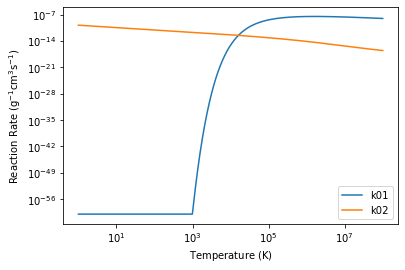
Visualize the rate as a function of temperature
import numpy as np
import matplotlib.pyplot as plt
from dengo.chemistry_constants import tevk

class state:
    def __init__(self, T_bounds=(1, 1e8), n_bins=1024):
        """Initialize the range of temperature over which the rate tables are generated

        Parameters
        ----------
        T_bounds: List[Float, Float], optional (default=(1,1e8))
            the range over which the rates table is interpolated

        n_bins: int, optional (default=1024)

        """
        self.n_bins = n_bins
        self.T = np.logspace(
            np.log(T_bounds[0]), np.log(T_bounds[1]), n_bins, base=np.e
        )
        self.logT = np.log(self.T)
        self.tev = self.T / tevk
        self.logtev = np.log(self.tev)
        self.T_bounds = T_bounds


temperature_state = state()


rxnk01 = reaction_registry['k01']
rxnk02 = reaction_registry['k02']
temperature = temperature_state.T
rxnk01_rate = rxnk01.coeff_fn(temperature_state)
rxnk02_rate = rxnk02.coeff_fn(temperature_state)

plt.loglog(temperature, rxnk01_rate, label='k01')
plt.loglog(temperature, rxnk02_rate, label='k02')
plt.xlabel(r'Temperature $(\rm K)$')
plt.ylabel(r'Reaction Rate $(\rm g^{-1} cm^{3} s^{-1} )$')
plt.legend()
plt.legend()
<matplotlib.legend.Legend at 0x7f7fa2689f70>