
Threebody Reaction Example
Contents
Threebody Reaction Example
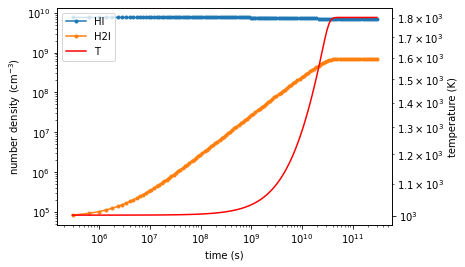
At density of \(n \sim 10^8 cm^{-3}\), molecular hydrogen begins to form more effectively through the three-body reaction channel, i.e. $\(\mathrm{H +H + H \rightarrow H_2 + H}\)$ The collapsing gas undergoes a rapid transition from being atomic to almost fully molecular via this process. since this process evolves rapidly, this often poses a challenge to the stability of the solver. Here we investigate in particular this process in detail.
# importing necessary libraries
import pyximport
import numpy as np
import os

from   dengo.chemistry_constants import tiny, kboltz, mh, G
import dengo.primordial_rates
import dengo.primordial_cooling

from dengo.chemical_network import \
    ChemicalNetwork, \
    reaction_registry, \
    cooling_registry, \
    species_registry
import dengo.primordial_rates
import dengo.primordial_cooling

import sympy
from sympy import lambdify
import matplotlib.pyplot as plt
Create a simple network
Let’s consider only the most significant reactions at high densities, and compare it with the full network with 22 reactions. Similar to the previous example, we have to register our required reactions/ cooling actions, then add reactions to the dengo.chemical_network.ChemicalNetwork object.
\begin{align} \quad \mathrm{H_2 + H} & \mathrm{\rightarrow 3H} \ \quad \mathrm{H + H + H} & \mathrm{\rightarrow H_2 + H} \end{align}
# we register the rates predefined in dengo.primordial_rates
# so that they can be imported into our network object
dengo.primordial_rates.setup_primordial()

# create our network and add reactions to it
cn_simple = ChemicalNetwork()
cn_simple.add_reaction("k13")
cn_simple.add_reaction("k22")
cn_simple.add_cooling("h2formation")
cn_simple.init_temperature()
Adding reaction: k13 : 1*H2_1 + 1*H_1 => 3*H_1
Adding reaction: k22 : 2*H_1 + 1*H_1 => 1*H2_1 + 1*H_1
Generate templates
With the ChemicalNetwork object, Dengo can write the C solver.
The corresponding auxillary library paths are needed to be set as the environomental variables, in order to compile our python modules.
HDF5_DIR (HDF5 installation path)
CVODE_PATH (CVode installation path)
SUITESPARSE_PATH (SuiteSparse library which is optional unless we use
KLUoption)DENGO_INSTALL_PATH (Installation Path of Dengo)
ChemicalNetwork.write_solver writes serveral files
Main components that drives Dengo
_solver.h
_solver.C (major modules in Dengo)
_solver_main.h
_solver_main.C (example script to use the C library)
initialize_cvode_solver.C (wrapper function for the CVode library)
Makefile (to compile the dengo library
libdengo.a)
Helper function to compile Dengo C files for Python wrapper
_solver_run.pyxbld
_solver_run.pyxdep
_solver_run.pxd
_solver_run.pyx (major Python wrapper)
output_dir = "."
solver_name = "simple"

# write the solver
cn_simple.write_solver(solver_name, output_dir=output_dir,
                solver_template="cv_omp/sundials_CVDls",
                ode_solver_source="initialize_cvode_solver.C")

# install the library
pyximport.install(setup_args={"include_dirs": np.get_include()},
                  reload_support=True, inplace=True)

# load the compile library
simple_solver_run = pyximport.load_module(
    "{}_solver_run".format(solver_name),
    "{}_solver_run.pyx".format(solver_name),
    build_inplace=True, pyxbuild_dir="_dengo_temp")
You have suitesparse!
/home/kwoksun2/anaconda3/lib/python3.8/site-packages/Cython/Compiler/Main.py:369: FutureWarning: Cython directive 'language_level' not set, using 2 for now (Py2). This will change in a later release! File: /mnt/gv0/homes/kwoksun2/dengo-merge/cookbook/simple_solver_run.pxd
  tree = Parsing.p_module(s, pxd, full_module_name)
cc1plus: warning: command line option '-Wstrict-prototypes' is valid for C/ObjC but not for C++
cc1plus: warning: command line option '-Wstrict-prototypes' is valid for C/ObjC but not for C++
cc1plus: warning: command line option '-Wstrict-prototypes' is valid for C/ObjC but not for C++
Specifying Initial Condition
Our Python wrapper takes the initial condition as a dictionary. We write a handy function to help us generate initial conditions with a few parameters, density, temperature, and mass fraction of molecular hydrogen. Once the abundance of the major species are specified, we can calculate the free electrons de with the ChemicalNetwork.calculate_free_electrons.
To calculate thermal energy from density and temperature, \begin{equation} \mathrm{ge} = \sum_{i \in \mathrm{species}} \frac{n_i k T}{\gamma_i - 1} \end{equation}
where \(n_i\), \(\gamma_i\) are the number density and the specific heat ratios of the \(\mathrm{i^{th}}\) species. For some species like molecular hydrogen \(H_2\), the specific heat ratio \(\gamma_{\mathrm{H_2}}\) is temperature dependent. At low temperature, the molecule behave as if a monoatomic gas which has a \(\gamma = 5/3\). As the temperature increases, the available thermal energy is large enough and is then capable of driving the 2 extra rotational degree of freedom.
H2I = species_registry['H2_1']
gammaH2 = cn_simple.species_gamma(H2I, temp=True, name=False)
fgamma = sympy.lambdify("T", gammaH2)
plt.semilogx(cn_simple.T, fgamma(cn_simple.T))
plt.xlabel("Temperature ($\mathrm{K}$)")
plt.ylabel("Specific Heat Ratio ($\gamma_{\mathrm{H_2}}$)")
plt.savefig("gammaH2.png")

def setup_initial_conditions(network, density, temperature, h2frac, NCELLS):
    # setting initial conditions
    temperature = np.ones((NCELLS))*temperature
    init_array = np.ones(NCELLS) * density
    init_values = dict()
    init_values["H_1"] = init_array * 0.76 * ( 1-h2frac )
    init_values['H_2'] = init_array * tiny
    init_values['H_m0'] = init_array * tiny
    init_values['He_1'] = init_array * 0.24
    init_values['He_2'] = init_array * tiny
    init_values['He_3'] = init_array * tiny
    init_values['H2_1'] = init_array * 0.76 * h2frac
    init_values['H2_2'] = init_array * tiny
    init_values['de'] = init_array * tiny

    # update and calculate electron density and etc with the handy functions
    # init_values = primordial.convert_to_mass_density(init_values)
    init_values['de'] = network.calculate_free_electrons(init_values)
    # init_values['density'] = primordial.calculate_total_density(init_values)
    init_values['density'] = np.ones((NCELLS))*density
    number_density = network.calculate_number_density(init_values)

    # set up initial temperatures values used to define ge
    init_values['T'] = temperature

    # calculate ge (very crudely, no H2 help here)
    gamma = 5.0/3.0
    mH = 1.67e-24
    init_values["ge"] = 3.0 / 2.0 * temperature * kboltz / mH

    return init_values
Running the Wrapper
Once the initial condition is specified, we can finally solve some chemistry.
{{solver_name}}_solver_run.run_{{solver}}
states (initial condition)
dtf (evolved time in seconds)
niter (maximum number of iteration)
reltol (relative tolerance level of the solver; 0.001 => 0.1% level)
niter specify somehow the initial timestep \(dt = \mathrm{dtf/niter}\). After every succesful integration, the timestep is increased to \(1.1 dt\), and the solution is accumulated until the evolution timescale reaches dtf. In the following example, we blow up the niter, so that we can track the actual evolution of the system with time.
# Initial Conditions
density = 1e10 # number density
temperature = 1000.0 # K
H2Fraction  = 1.0e-5 # molecular mass fraction
ncells = 1 # number of cells

# freefall timescale
dtf = 10.0/ np.sqrt(G*mh*density)

states =  setup_initial_conditions(cn_simple, density, temperature, H2Fraction, ncells)
rv, rv_int = simple_solver_run.run_simple(states, dtf, niter=1e6, reltol = 1.0e-6)
Successful iteration[ 0]: (2.995e+05) 2.995e+05 / 2.995e+11
Successful iteration[  100]: (4.128e+09) 4.540e+10 / 2.995e+11
End in 121 iterations: 2.99536e+11 / 2.99536e+11 (0.00000e+00)
Let’s plot the result!
flag = rv_int["successful"]
t    = rv_int["t"][flag]
H2I  = rv_int["H2_1"][0][flag]
HI   = rv_int["H_1"][0][flag]
T    = rv_int['T'][0][flag]

f, ax = plt.subplots(figsize=(6,4))
ax.loglog(t, HI, marker= '.', label='HI')
ax.loglog(t, H2I, marker= '.', label="H2I")
ax.set_xlabel("time (s)")
ax.set_ylabel("number density $(\mathrm{cm^{-3}})$")

ax2 =ax.twinx()
ax2.loglog(t, T, color='r', label='T')
ax2.set_ylabel("temperature (K)")

lines, labels = ax.get_legend_handles_labels()
lines2, labels2 = ax2.get_legend_handles_labels()
ax2.legend(lines + lines2, labels + labels2)
<matplotlib.legend.Legend at 0x7f5f120ba4f0>
Equilibrium \(\mathrm{H_2}\) fraction
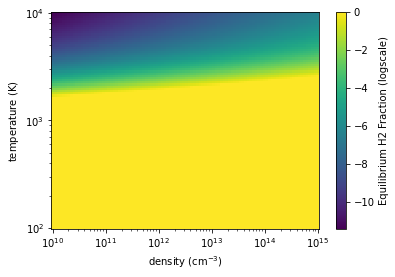
With Dengo, we can analytically evaluate the molecular hydrogen fraction with Sympy. We can compare and see if it matches up with what we see from the actual evaluation.
\begin{equation} \begin{split} \frac{d \mathrm{H_2}}{dt} &= −k13 ~ \mathrm{H_2 ~ H} +k22 ~ \mathrm{H^3} = 0 \ \mathrm{H_2} &= \mathrm{\frac{k22 ~ H^2}{k13}} \end{split} \end{equation}
We can get the first equation \(\frac{d \mathrm{H_2}}{dt}\) from ChemicalNetwork.species_total("H2_1"). We can solve the above equation with sympy.solvers.solve.
eq = cn_simple.species_total("H2_1")
eq
equil_h2 = sympy.solvers.solve(eq, "H2_1")
equil_h2[0]
Evaluate the Reaction Rates
reaction rates are dependent of temperature, as of now, it is a little tricky to calculate them in dengo, this will be made easier in the later version of dengo
from dengo.chemistry_constants import tevk
class TemperatureClass():
    def __init__(self, T):
        self.T = T
        self.logT = np.log(self.T)
        self.tev = self.T / tevk
        self.logtev = np.log(self.tev)
        self.threebody = 4

def get_rate_by_temp(states, species, network):
    T = states["T"]
    # this class can be ingested by dengo functions to obtain corresponding rates
    tc = TemperatureClass(T)
    # reaction rates:
    rates = {}
    for rn, rxn in sorted(network.reactions.items()):
        eq = rxn.species_equation(species)
        if eq == 0: continue
        rates[str(rxn.coeff_sym)] = rxn.coeff_fn(tc)
        print(rxn)
    return rates

def evaluate_expression(states, rates, equation):
    sym_fs = list(equation.free_symbols)
    sym_arg = []
    for s in sym_fs:
        # drop ge cos this is reaction rate is implicit function of temperature
        if not str(s) == "ge":
            sym_arg.append(s)

    states.update(rates)
    # prepare arguments in correct order to be put into the lambdify equation
    val_arg = []
    for a in sym_arg:
        if str(a) == 'ge': continue
        val_arg.append(states[str(a)])

    # need to lambdify to take arrays as input
    f = lambdify(sym_arg, equation)

    return f(*val_arg)

def evaluate_equilibrium_H2( h1_density, temperature, network):

    states = {}
    states["H_1"] = h1_density
    states["T"] = temperature
    rates = get_rate_by_temp(states, "H2_1", network)

    eq = network.species_total("H2_1")
    equil_h2 = sympy.solvers.solve(eq, "H2_1")
    if len(equil_h2) > 1:
        equil_h2 = equil_h2[1]
    else:
        equil_h2 = equil_h2[0]
    return evaluate_expression(states, rates, equil_h2)
Visualize the equilibrium \(\mathrm{H_2}\) landscape
temp_arr = np.logspace(2, 4, 100)
dens_arr = np.logspace(10, 15, 100)
temp2d, dens2d = np.meshgrid(temp_arr, dens_arr)

equilH2_2d = evaluate_equilibrium_H2( dens2d, temp2d, cn_simple)

h2frac = equilH2_2d / dens2d
h2frac[h2frac > 1] = 1.0

plt.pcolormesh( dens2d, temp2d,  np.log10( h2frac ))
plt.xscale("log")
plt.yscale("log")
plt.xlabel("density ($\mathrm{cm^{-3}}$)")
plt.ylabel("temperature ($\mathrm{K}$)")

cbar = plt.colorbar()
cbar.set_label("Equilibrium H2 Fraction (logscale)")
k13 : 1*H2_1 + 1*H_1 => 3*H_1
k22 : 2*H_1 + 1*H_1 => 1*H2_1 + 1*H_1
Let’s overlay the equilibrium \(H_2\) in the above plot!
flag = rv_int["successful"]
t    = rv_int["t"][flag]
H2I  = rv_int["H2_1"][0][flag]
HI   = rv_int["H_1"][0][flag]

f, ax = plt.subplots(figsize=(6,4))
ax.loglog(t, HI, marker= '.', label='HI')
ax.loglog(t, H2I, marker= '.', label="H2I")
ax.set_xlabel("time (s)")
ax.set_ylabel("number density $(\mathrm{cm^{-3}})$")

equil_H2 = 2.01588 * evaluate_equilibrium_H2( HI, T, cn_simple )
ax.loglog(t, equil_H2 , ls = '--', label="Equilibrium")

ax2 =ax.twinx()
ax2.loglog(t, T, color='r', label='T')
ax2.set_ylabel("temperature (K)")

lines, labels = ax.get_legend_handles_labels()
lines2, labels2 = ax2.get_legend_handles_labels()
ax2.legend(lines + lines2, labels + labels2)
k13 : 1*H2_1 + 1*H_1 => 3*H_1
k22 : 2*H_1 + 1*H_1 => 1*H2_1 + 1*H_1
<matplotlib.legend.Legend at 0x7f5f11ce6250>
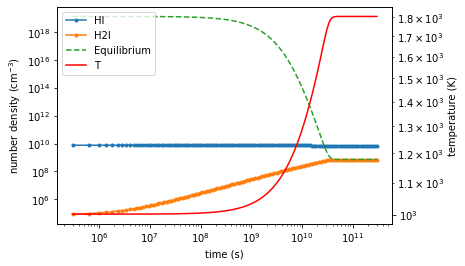
voila! they matches up nicely when the equilibrium is reached!
this acts as a nice sanity check on both our solver, and our understanding of the network